
Scotch and Soaring Energy Bills
The industry's commitment to net zero has been given added urgency by the recent spike in oil prices cause by the Iran conflict. While prices fell last week, the situation remains volatile. Ron Emler explores how distillers are striving to constrain mounting energy costs …
Distilling is an energy-intensive process, accounting for 50% - 70% of Scotch whisky production costs, so it is no wonder that distillers are seeking every way possible to contain the sudden escalation in energy bills, especially as they also affect the supply chain from farming and malting through to packaging and shipping.
The Scotch industry has pledged to reach net-zero emissions across its entire supply chain by 2045, aligning with Holyrood's broader climate goals. But for many distillers transitioning to renewable energy, implementing waste-reducing circular economies and lowering supply chain emissions cannot come quickly enough. They are all looking for quick wins as forerunners to longer-term solutions, but there is no one-size-fits-all template to follow.
Distillery design consultant Gareth Roberts says: "The main efficiency that distillers can control themselves is to reduce the cost of production by upgrading plant, equipment and buildings." The rising cost of energy has hit the industry just as global demand for Scotch is in a trough, so production is being reined back - without fanfare - either by eliminating night shifts or reducing runs, both of which cut expenses.
Diageo has paused malting at its Roseisle facility near Elgin but distilling continues, while Brown Forman has cut its payroll on Speyside with Glenglassaugh "sharing" a production team with Benriach with "periods of production" alongside "occasional" silent seasons. Over the medium-term, however, significant saving of energy and reducing costs requires capital investment.
Ronald Daalmans, Head of Environmental Sustainability at Chivas Brothers says: "Improving efficiency is critical to both commercial and environmental success. Distillation is inherently energy‑intensive, so our focus has been on significantly reducing energy use within the process." By using various heat‑recovery technologies to capture and reuse heat that would otherwise be lost, he claims significant success. "At our Glentauchers Distillery in Keith, we've achieved a 12:1 return in energy efficiency, reducing total energy consumption by nearly half (48%) and cutting site carbon emissions by more than half (53%)." Chivas Brothers has made the technical data freely available across the industry and estimates that if these technologies were adopted by every malt distillery in Scotland, the energy saved could power every home in Edinburgh and Aberdeen for a year.
But as Gareth Roberts points out: "costly capex investments are beyond the capabilities of smaller producers. Complex heat recovery systems could cost a large proportion of the investment made in an entire small distillery." What is undeniable, however, is a trend for distillers to seek security of supply and cost efficiency in the longer term by using renewable energy or generating their own power.
Rob Davies, Diageo's Head of Scotch Sustainability, says: "Several of our sites have moved across to biofuel and renewable energy sources. Cameronbridge is undergoing a huge electrification project that will reduce its emissions by 90% compared to a 2020 baseline. The project will ensure the annual energy demand is powered entirely by renewable sources. "We've also invested in biomass and biofuel. At Clynleish, we have a biomass plant and we're installing a steam line running from Clynleish to provide biomass steam to Brora. At Oban, Royal Lochnagar and Lagavulin we use biofuel to power the boilers. And when Port Ellen reopened in 2024 it was designed with sustainability at its core with heat and water reused and all thermal energy produced by a renewable-biofuel boiler."
Diageo's Leven plant is one of the largest packaging sites in Europe and is home to an 8,000-panel solar array which supplies 22% of the site's energy, rising to 60% in the summer. "It's also got air source heat pumps," Rob Davies says, "which provide heating across our packaging halls and generates over three times more thermal energy than electrical energy used to drive the pump." Yet some distillers are reluctant to instal solar panels because of the danger of sparks during storms and fears of an unwanted tragedy.
While the industry's two biggest players are investing heavily in energy cost reduction, small and remote distillers are also getting to grips with their own sums.
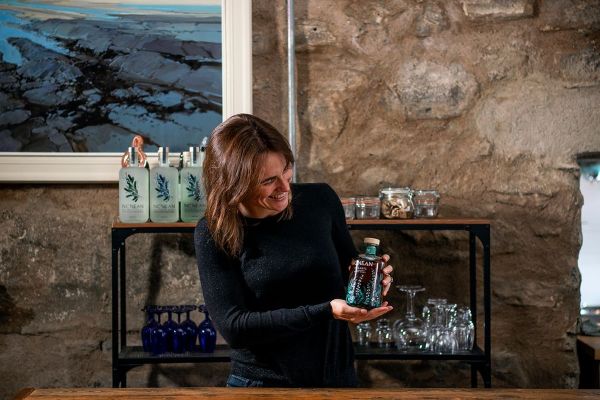
When Annabel Thomas set up Nc'Nean in 2016 she insisted on a bio-mass boiler for its green credentials. "It was extremely expensive but we're in a very remote place so having your own source of energy onsite at the end of a long single-track road is important," she says. And as fossil fuel prices rise Nc'Nean's bio-mass boiler is fast approaching payback. The wood comes from renewable local forests, which have little other commercial value due to the uncompetitive cost of transporting the timber, so there is a symbiosis between two local ventures. "We don't use very much electricity because we're at the end of a very long, single phase power cable, which has very limited capacity," she says. "Even if we weren't trying to reduce that energy usage for the right reasons, we've been forced to by circumstance." Wind generation would have met enormous environmental objections, and excess electricity could not have been sold to the grid because the single-line supply to Nc'Nean would have been incapable of carrying it.
At the Ardnamurchan distillery in Argyll all the power and heat requirements come from local renewables. The river that provides the distillery's cooling water has a hydro generator, solar panels provide alternative energy, and the biomass boiler is fuelled by wood chip from local forestry. A bio-mass facility has also been put into Whyte & Mackay's Jura distillery that uses a ground-breaking process to pulverise timber into wood dust, which burns with greater efficiency.
Technological revolution is at the heart of Annandale's determination to become the first zero-carbon Scotch whisky distillery. It is trialling a 36MWh unit to efficiently convert air to steam using a grid connection and a giant thermal store. The plan is to operate seven days a week, using off-peak capacity from excess wind generation.
Geo-thermal energy is often cited as a future power source but because it needs to be boosted by electricity "heat pumps are not remotely close to giving free heat," says Gareth Roberts, who has recently commissioned a steam-free distillery in Ireland. Owners Gareth and Michelle McAllister decided that distilling is possible without expensive generation of steam, so at Ashcragh in Galway all the heat used is recirculated and boosted using a very specialised heat pump to generate the high temperatures needed. "I've been speaking to them about bringing that to Scotland, to do a heat pump distillery for Scotch whisky," says Roberts, "but at present plans are only formative".
Meanwhile, the hoped for revolution in hydrogen power seems some way off. The gas is cheap to produce but because of its huge bulk it is very expensive to transport, ruling it out for most distilleries, especially those in the Highlands and Islands. "However, if you are installing a new gas boiler," says Roberts, "make sure it can be converted to hydrogen by a simple change of the burner. One day it might pay off."
Ron Emler is a financial journalist who has observed the drinks industry for 50 years. Following a career on The Times and the Sunday Telegraph, he is consultant City Editor at The Drinks Business.