
Jura – Behind the Label
When the Isle of Jura distillery was reborn in 1963, its task was to provide jobs for the islanders. A token single malt was launched a decade later, but no-one in their wildest dreams imagined quite how big it would get as Tom Bruce-Gardyne reports …
Years ago, whisky drinkers were asked on social media if they could help solve a mystery. They were shown a map of the indented coastline of Argyll with the Mull of Kintyre hanging like a limp arm by its side and the scattering of islands beyond.
But there was no sign of the Isle of Jura. Could anyone locate the island and its famous distillery? 'X marks the spot … and you could win yourself a bottle.'
With this whisky version of those old 'spot the ball' competitions, you wonder how many consumers had a clue where to place Jura, then or now. This relatively remote, tear-shaped island off the coast of Islay has a population of less than 250. It takes two ferries to get there and receives not a lot of visitors as a result.
A far greater presence is enjoyed by its whisky which in 2023 became the biggest selling single malt in the UK off-trade by volume and value. It was an incredible achievement for this tiny island whose distillery is itself something of a miracle.
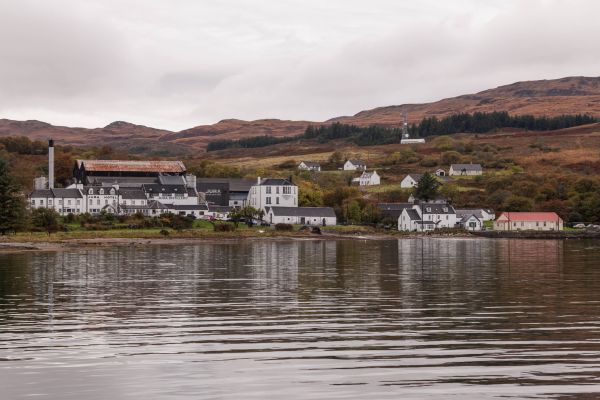
The current Isle of Jura distillery dates from 1963 and owes its existence to an earlier distillery from 1810 which closed before the First World War. The roof had been ripped off to avoid paying rent, but its shell remained among the few houses, the solitary shop and hotel of the capital – Craighouse.
It was proof that whisky production was possible on Jura. For two of the big landowners – Robin Fletcher and Tony Riley-Smith it suggested a cure for the island's most chronic problem at the time – depopulation. Build a distillery and provide employment, and you might just staunch the flow of people leaving for the mainland.
In a sense Jura was Scotland's first social distillery, backed by a consortium including William Delmé-Evans who had designed Tullibardine, and the blenders Chales Mackinlay & Co. The light, unpeated malt from its two, tall pot stills flowed into Mackinlay's blends which soon became part of Scottish & Newcastle (S&N). Yet, early on a few casks were set aside for an 8-year-old single malt that was launched in 1974.
An unsung hero in this story is Dr Alan Rutherford OBE, Jura's manager in the late 1970s who doubled the capacity to four stills. It was done without the prior consent of his boss at S&N which almost cost him his job, but without that expansion the distillery would never have survived the coming whisky loch.
Even so, Jura almost shut during the downturn, but Rutherford persuaded its new owners - Invergordon to close Glenallachie instead. The same nearly happened under Whyte & Mackay which bought Invergordon in 1994 and promptly closed Bruichladdich on Islay to cut back its malt production. Had Jura been picked, it wouldn't have come back.
Whyte & Mackay were slow to see the potential of single malts beyond Dalmore, but they did begin re-racking Jura into better wood from the rather knackered casks they had inherited from Invergordon. It took almost a decade and undoubtedly improved the quality.
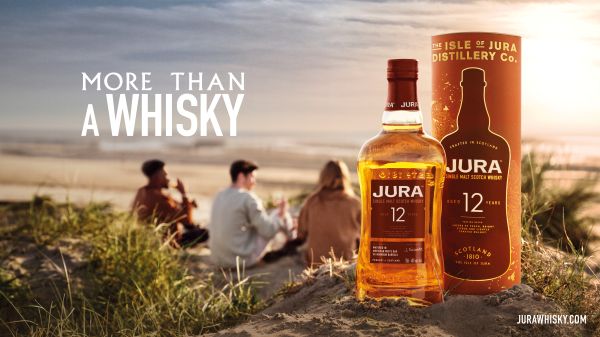
As a single malt in its curvy, pinch-shaped bottle, Jura has always lacked the fire and brimstone smoke of Islay which probably disappointed some drinkers. So, a number of peated expressions were released like Jura Prophecy in 2009. More were added until it all became a bit confusing.
"We had this really fragmented portfolio of smoky whiskies and sweet whiskies," explained Kirsteen Beeston, Whyte & Mackay's then head of international malts. "I don't think we'd ever really told the story of Jura as we were purely focused on unlocking the range."
That was in 2019 when the company launched a new TV campaign – 'Say Hello to Jura' that was packed with as many islanders as you could fit into a 30-second commercial. There was a realisation among the brand-owners that its greatest asset was Jura itself and the locals who live there. In Kirsteen's words: "To know the island story is to know the distillery, and vice versa. The two are completely inseparable."
The whisky sees itself as a distillation of its small, tight-knit community. It is a message that's easy to absorb on Jura, but progressively less so the further away you are. "I've been in the centre of Mumbai trying to explain to a group of bartenders that there are only a couple of hundred people who live on this very small island," says Jura brand ambassador and single malt specialist, Andy Lennie. "In the middle of a bustling city, it's very hard. But I think the concept of community resonates all over the world."
The old 'spot the island' competitions are long gone, and the marketing has shifted from location to the locals. Andy can't bring them with him, but he has developed a touchscreen map with pictures that pop up of the wildlife, the island's only road and the distillery's water source.
For most consumers, the point of connection, other than on the shelf is via social media, print and TV, and Jura's current strap-line – 'more than a whisky'. It has a strong route to market in the Philippines, home to Whyte & Mackay's parent company – Emperador Inc. Other export markets are developing, but there's a long way to go. Jura has certainly yet to conquer the States.
The latest rebranding has simplified the core range, with the flagship 12 Year-Old (formerly a 10 YO), joined by a 14 YO and a 'Rum' and 'Bourbon cask' edition. The packaging is bold and bright to catch the eye of fast-grazing supermarket shoppers. Regular deals help convert interest into action and attract the odd new recruit into malts. In the UK, Jura is a High Street brand, but it's also stocked by independents like Royal Mile Whiskies which carries a good range.
"I think we've done a great job of getting people into the category, and now we're trying to keep them on that journey by doing some really interesting bottles for more specialist markets," says Andy Lennie.
Jura's owners have contemplated creating a separate brand – something peat-soaked and more typically West Coast under a new name. It is a model pioneered by Tobermory on Mull, with its smoky sidekick, Ledaig. Maybe it's an idea worth revisiting?
Award-winning drinks columnist and author Tom Bruce-Gardyne began his career in the wine trade, managing exports for a major Sicilian producer. Now freelance for 20 years, Tom has been a weekly columnist for The Herald and his books include The Scotch Whisky Book and most recently Scotch Whisky Treasures.
You can read more comment and analysis on the Scotch whisky industry by clicking on Whisky News.