
From Field to Bottle
For years farmers brought their grain to the distillery to be malted and distilled, but that close bond was broken with the advent of contract maltsters in the 1960s. The supply chain became longer and recently it has become severely strained as Tom Bruce-Gardyne reports …
Two weeks ago, farmers from across Scotland descended on Edinburgh for their annual get-together at the Royal Highland Show. Amidst the livestock and gleaming farm machinery on display it was a chance to catch-up over a few drinks. Going by last year, more than 200,000 pints would have been drunk over the four days, and no doubt plenty of drams as well.
As reported, farmers have been hit hard by the current slump in Scotch whisky with the latest figures putting demand for malting barley down 17% – the biggest fall since records began in 1990. Distillers have slammed on the brakes, leading to stockpiles of grain and broken contracts between farmers and merchants.
The supply chain up to the distillery gate is under severe strain which has implications for sustainability at all levels. The space between the field and the distiller accounts for most of Scotch whisky's greenhouse gas emissions, and is at risk of becoming economically unsustainable.
Against this backdrop, the Scotch Whisky Association (SWA) hosted a panel discussion at the Highland Show on building greater resilience in the supply chain. "As a key component in the whisky-making process, a resilient grain supply is fundamental to the future success of our industry," said Ruth Piggin, the SWA's industry sustainability director.
"They just wanted to have an open conversation with distillers, maltsters, farmers, the NFU and industry experts about what risks are affecting us," explains Victoria Buxton, an agronomist and agricultural sustainability manager at Soufflet Malt (formerly Baird's malt) who was there.
"There's no doubt about it. It's an incredibly tricky time," she says of the barley growers. "I'm a farmer myself down in Norfolk, and I absolutely understand the gravitas of this."
Currently some three quarters of the grain, and over 90% of the malted barley used to make Scotch whisky is grown in Scotland. By comparison, the proportion of Irish whiskey distilled from Irish maize is much lower.
This should be a source of pride for the industry, but it feels somewhat taken for granted and drinkers of Scotch whisky probably assume the raw ingredients are homegrown. They are for now, but that may change.
Duncan Macalister, vice president of NFU Scotland describes relations with the whisky industry as "pretty open and honest" and "better than maybe they were." However, "if the price for malted barley is depressed further, arable farmers will need to look at other options, whether it's oats or wheat or grass," he says.
With a tonne of malted barley currently selling for about £170, and distillers expecting to get around 410 litres of pure alcohol per tonne, the grain accounts for a paltry 11.5p a bottle of Scotch single malt at standard strength. Raise that to £200 a tonne and it would add just 2p to a bottle.
Macalister understands the maths, but points out it doesn't much matter what price the grain is if the end result as bottled Scotch is not selling. "We appreciate the distillers are having a bad time at the moment", he says. "We've been to the maltsters, we've looked in their sheds and they are full of malted barley."
It is said that the barley in the bottle costs less than the cardboard tube around it. Put like that, he accepts it doesn't sound right. Victoria Buxton agrees and goes on to explain how the three strands of sustainability – economic, social and environmental, rely on each other like a three-legged stool. "If it isn't financially sustainable for the farmer, then it can't be sustainable," she says.
The viability of growing barley for the whisky industry is clearly tied to the yield per acre, and she worries that any premium paid to farmers for doing things more sustainably won't compensate for any loss in volume.
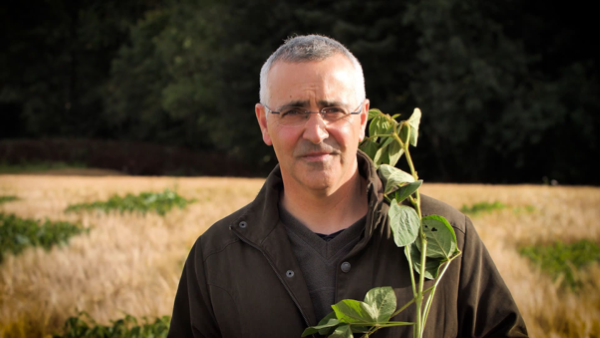
At the James Hutton Institute, plant biologist Pete Iannetta says: "I don't have the numbers to hand, but I'm convinced the price of sustainability is probably yield reduction." Who will pay for it is the big unanswered question.
In his view: "Scotland is a brand, particularly around whisky, and that brand only survives on the basis it continues to nurture its environment. Scotland has an image globally of being real, authentic and natural, but if you start scraping back the skin of that message it doesn't stand up."
He is great believer in peas and beans for their ability to fix nitrogen in the soil, and is partly responsible, at least indirectly, for Nàdar, the world's first climate positive gin made from peas. It was created by his former PHD student Kirsty Black, now Arbikie's master distiller.
While he is not proposing that Scotch should be made from peas, he believes a carbon-positive whisky from barley is possible, but "it would be scientifically credible only if the whole system is designed around proper accounting from the start." Unfortunately, there's an awful lot of greenwashing out there. Simply planting trees doesn't cut it.
In farming, the disconnect between the field and the product goes way beyond whisky of course. "We as farmers could help ourselves and have arrangements with distilleries so [the grain] becomes less of a commodity and the supply chain is tighter and closer," says Duncan Macalister
"I would love to come out of this with a closer relationship between farmers and the brands they are selling to," says Victoria Buxton. "I would love for everyone to use this shock and the move towards sustainability to get a closer relationship between the two."
An open discussion at the Highland Show is a good place to start. For a next step, an idea supported by Macalister at the NFU, why not be more transparent and put where the cereal comes from on the label?
Award-winning drinks columnist and author Tom Bruce-Gardyne began his career in the wine trade, managing exports for a major Sicilian producer. Now freelance for 20 years, Tom has been a weekly columnist for The Herald and his books include The Scotch Whisky Book and most recently Scotch Whisky Treasures.
You can read more comment and analysis on the Scotch whisky industry by clicking on Whisky News.