
Postcard from Korea
It's been a roller coaster ride for Scotch in South Korea. From being the sixth most valuable importer in 2010, this fickle market slumped in the following decade only to rebound in a post-Covid 'whisky craze'. A craze that appears to have fizzled out, reports Ian Fraser …
South Korea's rise from being one of the world's poorest countries in the aftermath of the 1950-53 Korean War to being its thirteenth-largest economy on the back of the manufacturing and technological prowess of "chaebols" such as Samsung, Hyundai, SK and LG, has been dubbed "the miracle on the Han River". However, the progress of the country's whisky market has been nowhere near as smooth.
Before the 2020-22 Covid pandemic, sales of whisky were skewed towards the traditional on-trade (TOT), which included "hostess bars" where businessmen were plied with drink by attractive young women, and basement noraebang (karaoke) lounges, where office workers went to unwind after work. In such establishments, market-exclusive blended Scotch brands such as Windsor, then owned by Diageo, and Pernod Ricard's Imperial, often bought on expenses, did well. Company dinners, known as "hoesik" where co-workers were expected to down endless shots of soju, mixed with beer – so-called "somaek" – were also de rigueur.
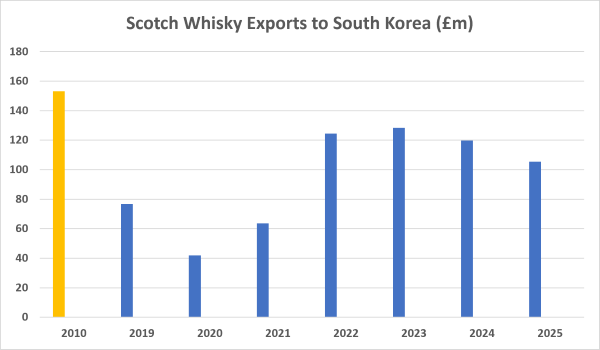
Jongmin Lee, vice-president of importers MetaBev Korea, says anti-corruption legislation such as the Kim Young-ran Act of 2016, and a crackdown on the use of company credit cards, put paid to much of that. In the short term, this change in the country's drinking culture spelt real pain for the Scotch industry, with exports halving from £153m in 2010 to £77m 2019.
A collapse along such lines might have been existential for the category in some markets. But not in South Korea.
Instead, the industry rebounded, with imports surging from £42m (6.6m 70cl bottles) in the peak Covid year of 2020 to £128.3m (14.4m 70cl bottles) in 2023 on the back of what The Korea Times calls a "whisky craze," which combined a surge in interest in highballs – blended Scotch and soda or ginger ale – with mounting enthusiasm for single malts.
"What happened during Covid is that, with the 10pm curfew, people started having house parties with small groups of close friends. This wasn't common in Korea before. For about three years, the culture shifted, as did interest in buying western liquor, especially whisky," says APAC marketing and hospitality consultant Matt Slonim.
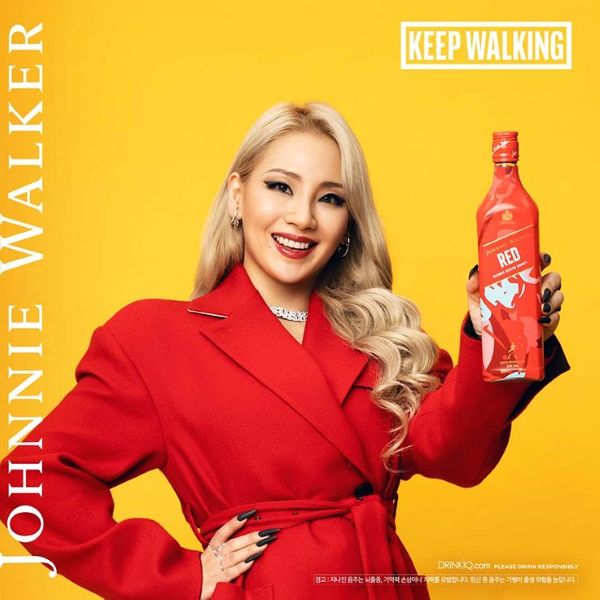
At around this time Diageo and Pernod Ricard sought to inject pizazz into their biggest blends by forming partnerships with Korean pop stars. In June 2021, Diageo's Johnnie Walker entered a deal with K-pop rapper CL, lead singer of girl band 2NE1. The following March, Pernod recruited Lisa of K-pop girl band Blackpink to its 'I Rise, We Rise' marketing campaign for Chivas Regal. This May, Johnnie Walker Blue Label partnered with Korean model and actor Byeon Woo-Seok.

To capitalise on the "highball fever" that had gripped Gen Z in Korea, Diageo has introduced a succession of Scotch blends which were previously unavailable here. First came Bell's, complete with a distinctive Union Jack label in 2017, then Black & White in 2025, and most recently White Horse, already the number one whisky in Japan, in April. Country-specific limited editions of existing single-malts and blends have also been a rich seam for whisky companies.
Myung Wook, adjunct professor at Sejong Cyber University's barista and sommelier department, told the Korea Times he believes the rise of home drinking caused Korean consumers to become much more discriminating – which in turn fuelled the rise of single-malts. "People also found out that limited-edition or luxury whiskies gain value if just kept at home. Therefore, many started to purchase them even if they don't drink at all – leading to short supplies of popular brand whiskies."
As sales through the TOT channel subsided, distillers and importers sought to boost their presence in the off-trade, often through cut-price promotions. In February 2025, hypermarket chain Emart ran a promotion for Black & White, selling it for just 9,900 won (£5) for a 70cl bottle. Suntory Global Spirits emulated this pricing strategy for Teacher's Highland Cream which launched here last December. Within three months, Teacher's had become the biggest-selling Scotch brand in the 18,000 convenience stores that are part of the GS25 chain.
More recently, Emart revealed that its whisky sales had surpassed those of domestic beer for the first time ever. Last month, Wine25+, an e-commerce offshoot of GS25, revealed that single-malt whisky had become the biggest-selling category of alcoholic drink on its platform, also for the first time. Balvenie 12- and 14-year-old, Glenfiddich 15-year-old, and Taiwanese single malt Kavalan Solist were among the top sellers.
"To compensate for slumping sales in the on-premise channel, major whisky importers cut supply prices by as much as 40-50% to dump volume into these large off-premise channels," says MetaBev's Lee. "Consequently, while whisky sales appeared to grow relative to beer or wine in these specific retail channels, almost all other on-premise and independent off-premise outlets experienced a decline."
Last December, the UK government signed an upgraded free-trade agreement with Korea to ensure that imported Scotch retains its tariff‑free status, irrespective of from where it enters the country.
However, Korea's "whisky craze" appeared to be losing momentum. Exports of Scotch whisky to the country declined from £128m in 2023 to £105m in 2025 – a fall of 17.8%. In volume terms, exports shrank by 23.6% – down from 14.4m 70cl bottles in 2023 to 11m last year.
"The whisky market in Korea swelled, but it's now shrinking again. The reality is most Korean consumers – especially younger, female ones – prefer alcohol that doesn't taste like alcohol," says Slonim. "Unfortunately, the home drinking culture dried up as soon as Covid was 'settled,' as did the cheaper import prices that occurred during that time. Those who really found themselves enjoying whisky during that period continue to drink it, but the rest have defaulted to soju."
Meanwhile, Korea's Ministry of Health and Welfare is introducing mandatory, graphic warnings on the dangers of excessive drinking and drink-driving on the front labels of all alcoholic-beverage bottles from November. While not as intrusive as the warnings on cigarette packets, these are regarded as particularly unwelcome by the trade, which fears they could be the thin end of a wedge.
Tougher economic times in Korea, including 3.2% inflation in June and higher housing costs, are taking their toll. Figures from the Korea Statistics Data Agency show that spending on alcohol per household fell to 13,000 won (£6.38) per month in the first quarter of 2026 – 9% down on the previous year. One-in-four moderating consumers said they were cutting their consumption due to financial pressures, with a third saying they now only drink alcohol on special occasions.
MetaBev's Lee says: "The rebound that began in 2022 has clearly hit a plateau, and growth is unlikely to be sustainable without a broader economic recovery."

Ian Fraser is a financial journalist, a former business editor of Sunday Times Scotland, and author of Shredded: Inside RBS The Bank That Broke Britain.