
Behind the Label – Laphroaig
The hoary old peat monster from Islay has been called many things over the years, not all of them polite. Laphroaig's owners welcome all opinions, good and bad, and as Tom Bruce-Gardyne discovers, they clearly relish how no-one is ambivalent about the taste …
"What's core to people's enjoyment of Laphroaig is the debate on what it actually tastes like," says Rod Gillies, brand director for the famous Islay single malt. Since its bicentenary in 2015 everyone from locals to its 700,000-strong Friends of Laphroaig fan-club, have waded in with their opinions about a whisky that 'Tastes like Heaven, and smells like Hell.'
"Don't get me wrong. It creates some issues when 10% of everyone who tries it, goes 'Oh, I don't like it'," he says, although the number of drinkers unconvinced by the whisky's prickly charms may be somewhat higher than that.
After a number of years at Whyte & Mackay, latterly as brand director for Dalmore, he joined Laphroaig last summer. "I'd always loved it from afar. It's always been one of my favourite whiskies," he says. "For me, I would much rather work on something that provokes a reaction because you're much more likely to get people who'll love it, alongside those who loathe it."
Just before he took on the role, another recruit had been signed up as the new global brand ambassador with decades of mainstream and arthouse movies behind him. Craggy and idiosyncratic, Willem Dafoe may not have quite the box-office draw of Harrison Ford at Glenmorangie, but he is pitch perfect for Laphroaig.
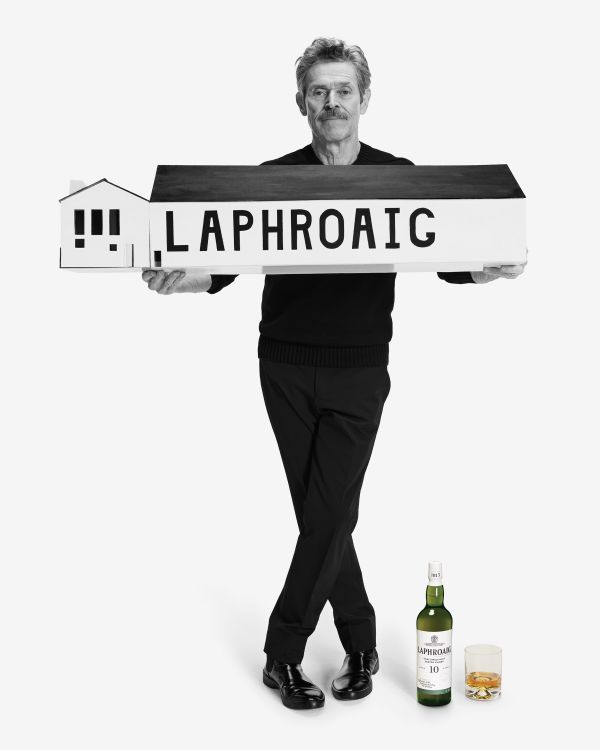
"When I was told, I couldn't believe how right it felt," says Rod. "He's an amazing character actor, with a really distinctive look and style." This comes through brilliantly in 'The Taste' a short film with Dafoe reading out descriptions from the Friends of Laphroaig. "Like sucking on a burnt match … like growing a beard in your throat …" he says, with infectious laughter.
"There is a little bit of an impression with single malt that you need to know about it before you're allowed to drink it," says Rod. Far better to speak of "burnt knickers" and "licked ash-trays" with Laphroaig, or just say "mmm, nice" like Harrison Ford on Glenmorangie.
In good Islay tradition, it is the heavy use of peat to malt the barley that gives the whisky its provocative taste, but its many fans and foes insist there is something unique about the peated character of Laphroaig.
For starters, it has its own source of Islay peat. "George [Campbell], the distillery manager talks about a single malt from a single bog," Rod explains. "You've got cold smoking where our peat smoulders rather than burns coating the grains to get a higher phenolic content. With our floor maltings, the windows are open to the sea which gives a saline character. And then we do a long fermentation and a long cut."
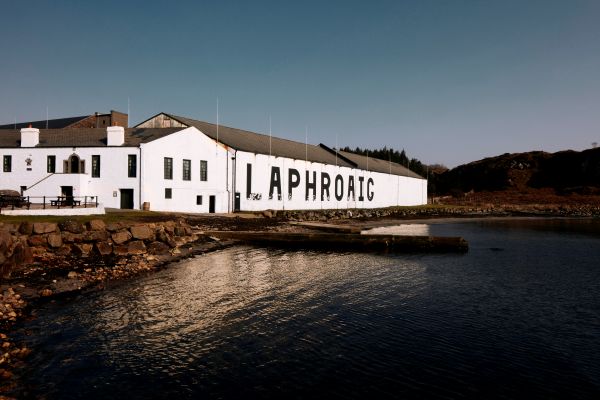
"Put all that together, and you get some really complex flavours," he says. "What I think is most interesting about Laphroaig is you get that medicinal, smoky punch on the nose, but it's surprisingly sweet and there's a real fruit character in there as well."
For all its challenging taste, Laphroaig is the world's best-selling peated whisky, and is currently eighth among Scotch single malts by value. Its key markets are the UK, Germany, France, travel retail and especially the US, where its flagship 10 year-old sells for around US$50-60, making it a "mainstream, reasonably accessible single malt," he says. "We haven't been releasing lots of older, more expensive editions. That's not Laphroaig's bag."
While trading conditions are pretty tough at present, he remains positive. "There's a little bit of doom and gloom circulating, and I don't buy it all," he says. "There's a fair amount of spirit kicking around, but we're slightly less exposed to that at Laphroaig. And the long-term macro trends are nothing but positive for single malt."
Well, as of 2024, US sales of malt were down to 1.7 million cases from a peak of 2.5m in 2021 according to the Distilled Spirits Council of the US, I point out. In response, he calls the comparison "slightly artificial," and says: "That was an absolute historic high driven by a very specific set of circumstances."
.jpg "Laphroaig x Willem Dafoe and a Barley Man")
"We're definitely seeing the situation improving with stock levels in the market, although it could be six to nine months before that translates into orders for producers." No doubt, America's notoriously cumbersome three-tier distribution system is not helping.
Moving to the industry's beloved mantra of premiumisation, he says "if it's about worldwide, growing middle-class households who are interested in good food and drink, that's a long-term trend that's continuing, even now." In developed markets however, he accepts the trend "has stalled in a lot of cases."
But with Laphroaig owned by Suntory since 2014, he sees lots of potential in the East. "I think there's a bit of a myth about Asian palates not liking peated whisky. Some of the brands that have done best there are unpeated and it's created an impression that's what works. Is there an opportunity for peated whisky to be 15-20% of single malts in China or Taiwan? Yes, I absolutely think there is. We just need to introduce people in the appropriate way."
This decidedly non-crowd-pleasing whisky knows what it's about, and as Adam Woodward wrote in a recent issue of Creative Review: "If the wider industry is sweating over declining sales, Laphroaig appears to be shrugging it off with characteristic confidence and a wry, wholehearted slàinte."
_0.jpg)
Award-winning drinks columnist and author Tom Bruce-Gardyne began his career in the wine trade, managing exports for a major Sicilian producer. Now freelance for 20 years, Tom has been a weekly columnist for The Herald and his books include The Scotch Whisky Book and most recently Scotch Whisky Treasures.
You can read more comment and analysis on the Scotch whisky industry by clicking on Whisky News.