
Liquid Sunshine
In a break from the usual weekly news cycle on Scotch, Ron Emler explores how the drink has inspired much wit and wisdom over the decades from authors, actors, screenwriters and the occasional politician …
There has never been a shortage of praise for Scotch. David Daiches, the Scots writer and critic, said in his 1969 book Scotch Whisky: "The proper drinking of Scotch whisky is more than indulgence; it is a toast to a civilisation, a tribute to the continuity of culture, a manifesto of man's determination to use the resources of nature to refresh mind and body and enjoy to the full the senses with which he has been endowed."
In Life on the Mississippi, Mark Twain wrote: "How solemn and beautiful is the thought that the earliest pioneer of civilisation, the van-leader of civilisation, is never the steamboat, never the railroad, never the newspaper, never the sabbath school, never the missionary – but always whisky!"
So, at the time of year when whisky is prominent as a symbol of celebration, given and received in friendship, having the appropriate quote or quip to hand enhances the enjoyment and adds to the appreciation of the generosity involved.
Often the writers themselves have led the way in their love of whisky.
"Too much of anything is bad, but too much of good whisky is barely enough" Twain famously declared, adding: "If I cannot drink bourbon and smoke cigars in Heaven, then I shall not go."
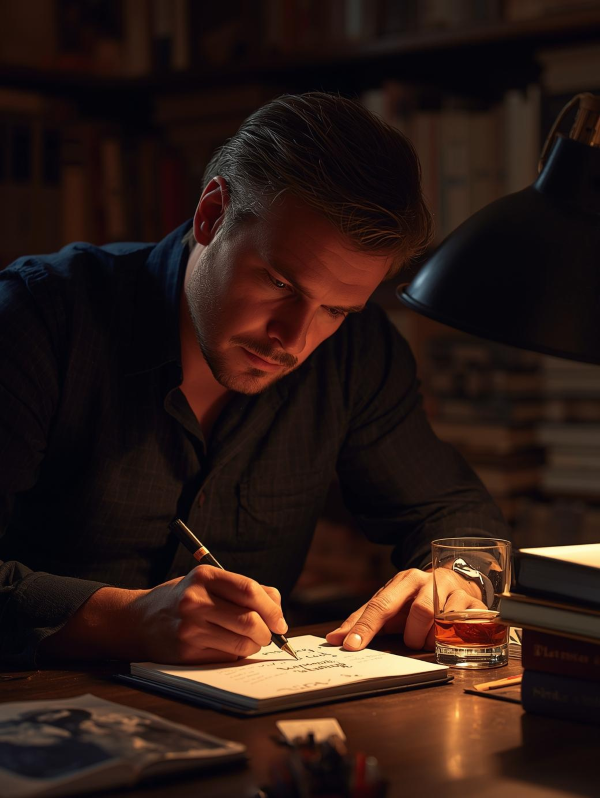
The British/American author and screenwriter Raymond Chandler (famed for archetypical crime novel The Big Sleep) wrote: "There is no bad whisky. There are only some whiskys (sic) that aren't as good as others."
William Faulkner, the godfather of the Southern Gothic genre, was partial to a dram. "The tools I need for my trade," he once quipped, "are paper, tobacco, food and a little whiskey." Ernest Hemingway, a toper of global renown, claimed to be able to tell at which precise points in a novel (and how copiously) Faulkner had refreshed himself.
Ian Fleming too loved a good glass, a trait he gifted to James Bond. In the first chapter of You Only Live Twice 007 consumes enough Sake to poleaxe the proverbial elephant, returns to his hotel room, and for breakfast orders a double portion of eggs Benedict which he washes down with a pint of Jack Daniels.
In Dubliners, James Joyce suggests that "The light music of whisky falling into glasses made an agreeable interlude", while for the acclaimed Japanese writer, Haruki Murakami, "Nights without work I spend with whisky and books." He went on to say that "Whisky, like a beautiful woman, demands appreciation. You gaze first, then it's time to drink."
Scots, of course, have long lauded their national beverage. According to Robert Louis Stevenson, whisky is "The king o' drinks, as I conceive it, Talisker, Isla, or Glenlivet!"
Famed for his 1947 comic novel Whisky Galore, Sir Compton Mackenzie opined; "Love makes the world go round? Not at all. Whisky makes it go round twice as fast." While in the late 18th century, Robert Burns decried the quality of most 'Scotch' at the time - "The whisky of this country is a most rascally liquor; and by consequence only drunk by the most rascally part of the inhabitants," he wrote in a letter to John Tennant in 1788.
Dylan Thomas's last words are reported to have been: "I've had 18 straight whiskies; I think this is a record." For George Bernard Shaw whisky was "liquid sunshine," but for his fellow Irishman, Oscar Wilde, it was work that was the "curse of the drinking classes."
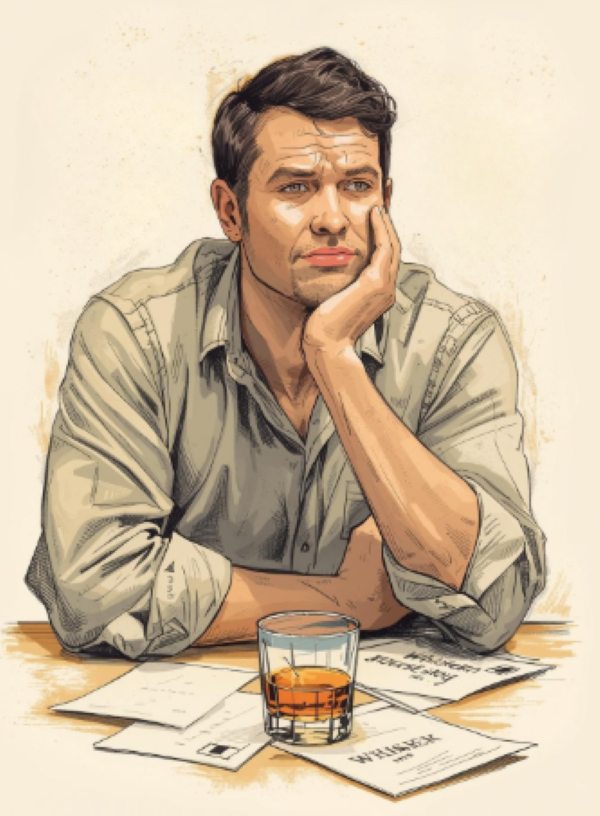
The drink has been hailed for its medicinal properties - "What whisky will not cure, there is no cure for." Some believe that penicillin was an even greater boon to human health, but its discoverer, Sir Alexander Fleming recommended "A good gulp of hot whisky at bedtime—it's not very scientific, but it helps."
Sir Winston Churchill's first love among drinks may have been Cognac and champagne, but he drank plenty of diluted Johnnie Walker. He had gained a taste for Scotch during the Boer War. "The water was not fit to drink," he wrote. "To make it palatable, we had to add whisky. By diligent effort, I learned to like it."
Frank Sinatra was never seen on stage without a glass nearby. "Alcohol may be man's worst enemy", he said, "but the Bible says love your enemy."
Likewise the Irish comedian Dave Allen who never performed without a dram within easy reach of his left hand with its index finger missing above the middle knuckle, while the iconoclastic journalist and critic, Christopher Hitchens, was rarely without a glass of "Mr. Walker's amber restorative".
"Always carry a flagon of whisky in case of snakebite," was W.C Fields' advice. "Furthermore, always carry a small snake."
Hollywood legend and Sinatra squeeze Ava Gardner was described by MGM studio head Louis B. Mayer as "She can't sing, she can't act, she can't talk – she's terrific!"
She wanted "to live to 150 years old, but the day I die, I wish it to be with a cigarette in one hand and a glass of whiskey in the other." Sadly, she achieved none of those ambitions when she died of pneumonia aged 67.
Humphrey Bogart's reported last words were: "I should never have switched from Scotch to Martinis." while legendary US TV host Johnny Carson believed that "Happiness is having a rare steak, a bottle of whisky, and a dog to eat the rare steak."
One of the finest recommendations for distilled water, yeast and fermented grain came from President Abraham Lincoln. In praising Civil War General Ulysses S Grant he asked: "Tell me what brand of whiskey that Grant drinks. I would like to send a barrel of it to my other generals."
Yet perhaps the wisest advice of all is simply: "Don't cry over spilt milk. It could have been whisky".
Ron Emler is a financial journalist who has observed the drinks industry for 50 years. Following a career on The Times and the Sunday Telegraph, he is consultant City Editor at The Drinks Business.