
Whisky à la Robo-Dog
The big breaking news story is the potential merger of Pernod and Brown-Forman and the marriage of Jameson and Jack Daniels. We will see how that pans out before assessing what it means for Scotch. Meanwhile Ron Emler is here to present Bacardi's new robotic dog …
The oak casks in which raw spirit matures into mellow, golden whisky are sometimes held to be the products of divine intervention. Without them being used by early distillers to transport Scotch whisky, it might have remained a localised, parochial endeavour and the products of what is now Scotland's third largest export industry might still be consumed only in remote glens, a byproduct of crofters' grain crops.
But the industry has a headache because, as the Book of Job tells us, "The Lord giveth and the Lord taketh away". Each year an average of 2% of the ethanol gently developing in the cask evaporates through complex interaction with the wooden staves.
This "Angel's share" is vital to the evolution of whisky. Without the effect of the ethanol escaping through the grains, distillates would remain harsh and immature.
The industry is keen to limit this to the bare minimum for obvious reasons. Letting too much ethanol escape is an excess cost and loss of profit, and yet too little disappearing into the heavens creates similar problems.
Much attention has focused on the wood itself, be it European or American oak, but whatever the source, the integrity of the individual cask is paramount.
While leaks are spotted easily, testing the volume evaporating from casks has been a skilled but highly unscientific task requiring warehousemen to periodically "knock" them and judge how much liquid remains inside based on sound; literally a "hit and miss" process. Inevitably human error means some faulty casks are missed.
As Angus Holmes, Whisky Category Director of Bacardi-owned John Dewar & Sons acknowledges, most casks develop a problem at some time. "How do we make sure that a cask has as much whisky in it as possible?" he asks.
"We are not interested in not having any losses [of ethanol] at all because we believe the Angel's Share contributes to the flavour of Scotch whisky. But they can be a bit greedy, so we want to make sure they are getting their 'fair' amount."
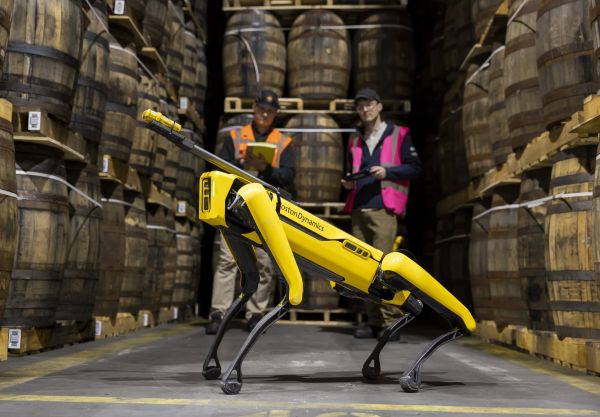
After all, Dewar's has more than 100 warehouses in Scotland, each containing up to 25,000 barrels, so the finances involved are significant, but Angus believes he has what is at least a partial solution to the conundrum, a robot dog that sniffs out defective casks.
In collaboration with the National Manufacturing Institute of Scotland based at Strathclyde University and US group Boston Dynamics, Dewars has tested a prototype. "We star ted talking about it in earnest last spring and we did the trails at the tail end of last summer. It takes only a second to test each cask," Angus says.
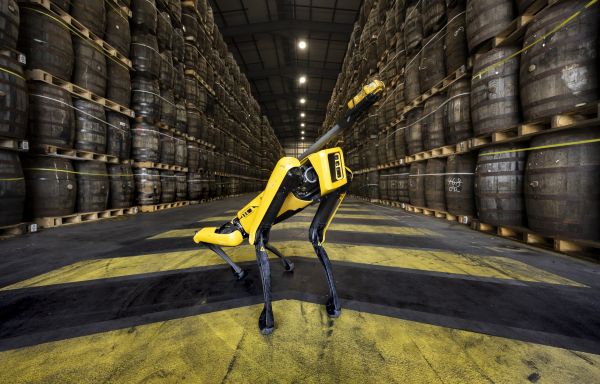
The dog-shaped robot is equipped with a very sensitive probe to sniff out the rate at which each cask is losing ethanol. Named Royal Barkla after Bacardi's Royal Brackla single malt from the distillery near Nairn, it has passed its training tests.
"We have proved that our robotic dog works", he says. "Up to now, we've saved a good few casks. The robot dog has delivered. It has created savings."
But Royal Barkla has one significant drawback. Even standing on its hind legs, its sensor can only probe to a height of two casks and palletised warehouses are often stacked seven or eight high. Can the sniffer sensor be taken to the upper levels?
"We're onto phases two and three of this project," says Angus. "We've been looking at drone technology. And we're also looking at a robotic spider that can climb around the warehouses. If we can link the sensor to the robot in some form of GPS location it will enable us to solve the problem."
When a cask is deemed to be letting too much ethanol evaporate the whisky inside is decanted and the barrel is sent back to the cooperage.
"Then it comes back in and it's got another 20 or 30 years," he says. "It's important to us that we keep the coopers employed. They are vital within the industry. They help us to create great Scotch Whisky so we need to keep them working."
There is an environmental plus as well. "The less (spirit) we lose the less we have to make originally, so less energy consumed," he says. "I wouldn't attempt to quantify it yet or say it has massive high green credentials at this stage, but it is picking up losses that we weren't previously picking up."
There are other potential benefits. Once fully developed the sniffer technology could be employed to reduce losses with ageing other spirits such as Patron (tequila) in Mexico or Angel's envy bourbon. "It's very much transferrable into our other brands," says Angus.
Regular and accurate assessment of each cask means Dewars can amass a vast database about sourcing casks, where to store them, their performance and how the whisky inside matures. Could that information be used to streamline other processes such as blending?
"No," says Angus." "What this is doing is measuring the ethanol loss with economic detectors. There are a lot more senses involved in blending. Nothing can take away from the skill, the nose, the taste of the blender."
"I think it is really important that when we talk about Scotch whisky that we really emphasise that the core of Scotch whisky is the traditional skills and experience.
"We're backed up by science but we definitely do not want to be in a position where robots are blending whisky. That is not the place to be. We are not interested in automating to take away the traditional skills. There are no plans to use robotics or any other technology to take away from the skill and craftsmanship of our people."
I'll drink to that.
Ron Emler is a financial journalist who has observed the drinks industry for 50 years. Following a career on The Times and the Sunday Telegraph, he is consultant City Editor at The Drinks Business.